
.svg)
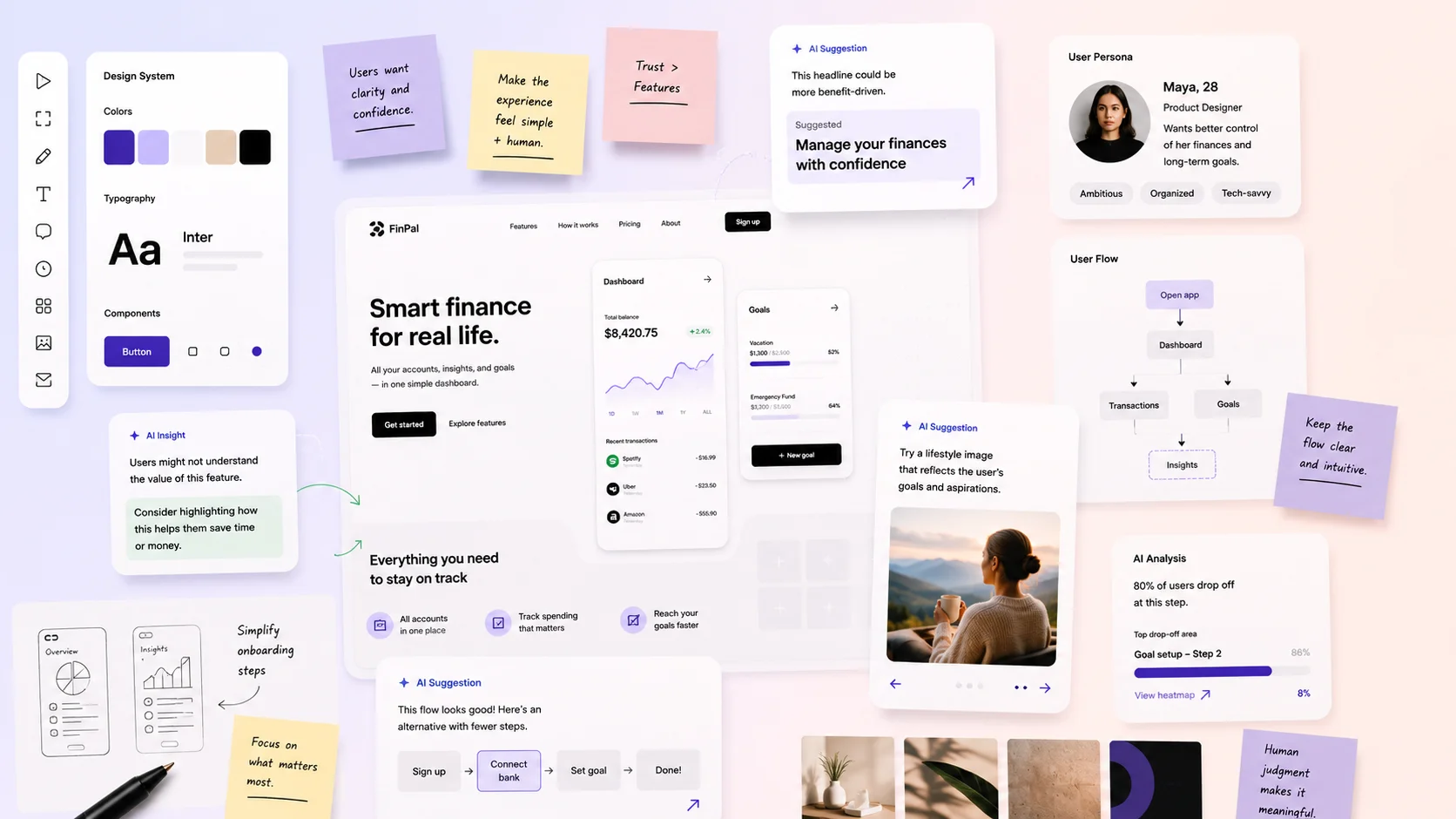
AI won’t replace design thinking — but it can sharpen it.
As designers, our value is not just in producing screens. It’s in understanding problems, asking better questions, and making thoughtful product decisions. Lately, I’ve been exploring how AI can support the early stages of the UX process, especially research, ideation, and user flow exploration.
What I’ve found is that AI is most valuable when it helps designers move from uncertainty to insight faster, giving us more time to focus on creating stronger and more intentional experiences.
Quick Answer: How can designers use AI without replacing design thinking?
Designers can use AI to speed up research, organize ideas, identify user pain points, explore user behavior, and pressure-test early user flow ideas. AI does not replace design thinking because designers still provide the strategy, judgment, empathy, and context needed to create meaningful user experiences.
What is AI’s role in the UX design process?
AI’s role in the UX design process is to support research, ideation, and decision-making. It can help designers explore problem spaces faster, generate early ideas, summarize information, and uncover possible user needs. However, AI should be used as a thinking tool, not as a replacement for human-centered design.
The biggest misconception about AI in design is that it exists to replace designers. In reality, AI is most useful when it helps designers work through the messy early stages of a project faster and with more clarity.
How can AI help designers during research?
AI can help designers during research by organizing information, identifying patterns, and surfacing potential user pain points. Instead of starting from a blank page, designers can use AI to quickly explore a product category, audience, or problem space.
This creates a stronger starting point for deeper research. The goal is not to blindly trust every AI-generated insight, but to use it as a way to ask better follow-up questions and move faster toward clarity.
How can AI improve ideation?
AI can improve ideation by helping designers explore multiple directions quickly. It can generate early persona ideas, user motivations, feature concepts, content angles, and possible user flow improvements.This is useful because good design rarely comes from the first idea. AI helps designers move through more possibilities faster, but the designer still decides what is useful, realistic, and aligned with the user’s needs.
Why does AI help designers ask better questions?
AI helps designers ask better questions by making it easier to challenge assumptions early. It can surface alternative scenarios, point out possible friction points, and help designers think through how different users might experience a product.
Sometimes the value is not the answer AI gives. The value is the next question it helps you ask.
Better questions lead to stronger UX because they improve how designers understand the problem before jumping into solutions.
What parts of design thinking should still come from the designer?
The designer should still lead strategy, empathy, prioritization, taste, context, and final decision-making. AI can suggest possibilities, but it cannot fully understand business goals, brand nuance, user emotion, or real-world constraints the way a designer can.
Designers are still responsible for deciding what matters, what to ignore, and how to turn insights into a clear user experience.
How does AI create more room for design thinking?
AI creates more room for design thinking by making the early research and ideation process more efficient. When designers spend less time stuck in uncertainty, they have more time to refine user flows, test interaction patterns, explore visual directions, and make stronger product decisions.
Used well, AI helps designers move from uncertainty to insight to iteration faster.
Final Answer: Will AI replace designers?
AI will not replace design thinking. It will sharpen it when used well.
The future of UX design is not designers versus AI. It is designers learning how to think better with it. AI can speed up research, expand ideation, and help teams explore problems more efficiently, but strong design still depends on human judgment, empathy, and strategic thinking.



.svg)